

Price Communication Is a Marketing Problem
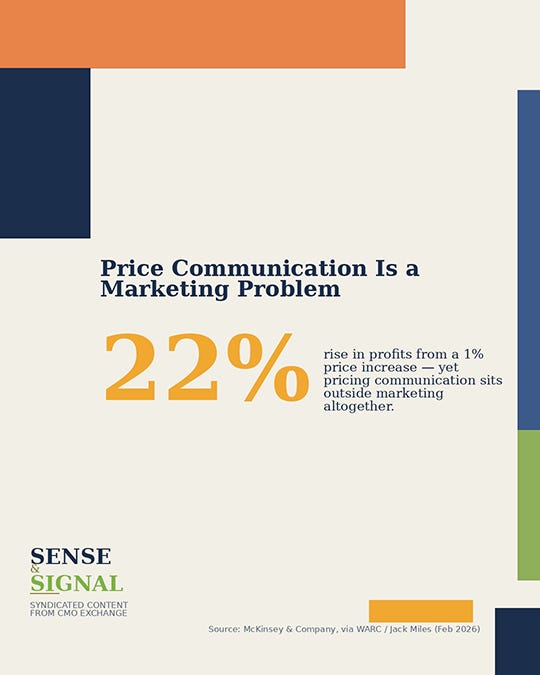
McKinsey research, surfaced by Jack Miles via WARC in February 2026, puts a precise number on something most senior leaders already sense: a 1% price increase can generate a 22% rise in profits. It is one of the highest-leverage moves available to any business. Yet in most organizations, pricing strategy sits in finance or revenue operations, and pricing communication sits somewhere in between, with marketing rarely owning either.
That is a structural problem with a real cost. How price is framed, contextualized, and communicated to a customer is not a finance function. It is a perception function. Whether a price reads as fair, premium, or unjustified depends almost entirely on what surrounds it: the brand, the narrative, the moment of decision. Those are marketing’s native territory, and most marketing teams are not in the room when pricing decisions get made.
What this means for your team
If your marketing team is not involved in pricing communication, that is worth raising with your CFO or commercial lead as a revenue conversation, not a turf conversation.
The CMO who can connect brand positioning directly to price perception has a materially stronger seat at the table than one who cannot.
Pricing power is not just a product or finance question. It is increasingly a brand question, and that means it belongs on the marketing agenda.
Sense & Signal is published by CMO Exchange. Each post translates one important signal shaping marketing leadership into clear editorial insight for senior marketing leaders.
Subscribe to receive each signal directly.